



Unlabeled Echoes

Pseudo-Labels and Genus-Aware Smoothing for Bat Call Recognition

Frank Fundel1    Alexandra Howard2

1Ludwig-Maximilians-Universität München, Germany  ·  2University of the Free State, South Africa

Paper PDF Demo - OpenEcho Code arXiv

TL;DR

Problem: Passive acoustic monitoring produces far more bat recordings than experts can label, leaving far more data unlabeled than labeled.

Idea: Simple pseudo-labeling uses unlabeled recordings effectively, while genus-aware smoothing adds biological structure to training.

Result: Strong gains across European and South African bat datasets.

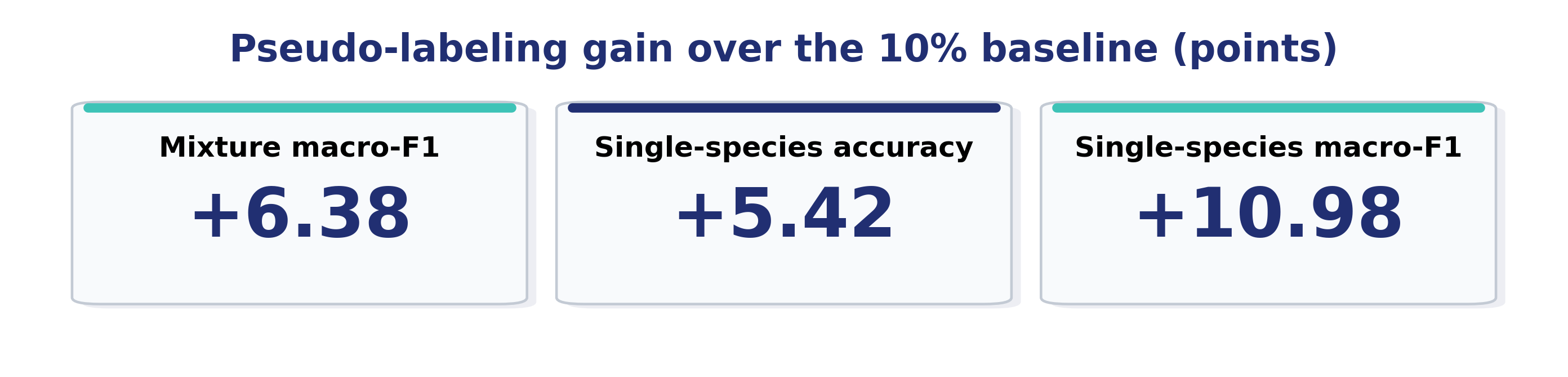
Pseudo-labeling gains over the 10 percent baseline: 6.38 mixture macro-F1 points, 5.42 single-species accuracy points, and 10.98 single-species macro-F1 points.
Learning from unlabeled data

Online pseudo-labeling with interleaved labeled updates.

A supervised BAT checkpoint turns unlabeled calls into hard one-hot targets and continues training on both human labels and model-generated labels.

1Labeled calls
and human annotations
2Supervised BAT
checkpoint
3Online hard targets
for unlabeled calls
4BAT self-training on
labels + pseudo-labels
Stable self-training. The pseudo-label loss is introduced gradually, while regular human-labeled updates keep early noisy predictions from dominating training.
Datasets

Two regions, two realistic unlabeled-data settings.

Skiba simulates label scarcity through a held-out split; UFS adds a separate pool of unlabeled field recordings.

Skiba

European archive · held-out split

Source archive
>1,500 recordings, 29 species, 96 kHz
Model outputs
18 species
Sequence split
19,030 total: 11,186 train, 2,890 validation, 4,954 test
Supervision
1,119 labeled training sequences (10%); 10,067 training sequences treated as unlabeled
UFS

South African archive · real unlabeled split

Source archive
>40,000 recordings, 17 species, about 15,000 without labels, 256 kHz
Model outputs
9 bat taxa + pesticide spray
Sequence split
15,863 labeled total: 6,736 train, 3,857 validation, 5,270 test
Supervision
30,000 additional unlabeled field sequences
Learning across classes

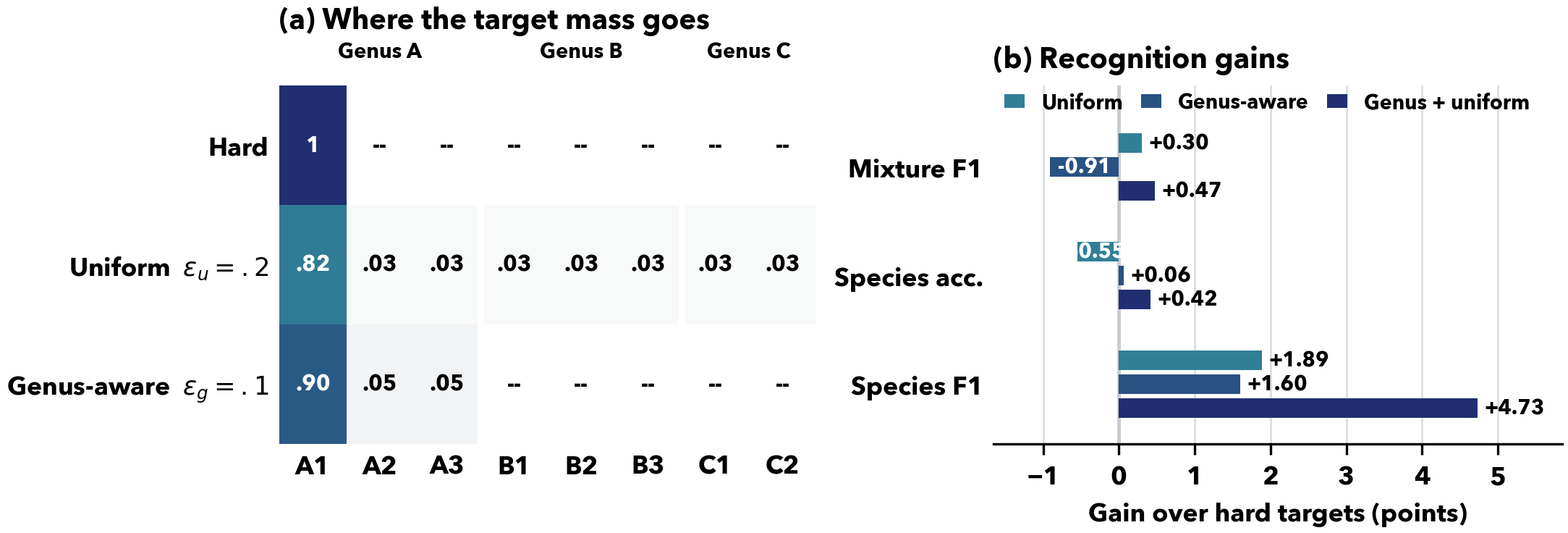
Genus-aware smoothing encodes plausible confusions.

Most target weight stays on the labeled species, while a small share goes to species from the same genus.

Comparison of hard, uniform, genus-aware, and combined smoothing targets, with absolute recognition gains over hard targets.
Results

Simple pseudo-labeling is a strong baseline.

Scores are percentages. Higher is better for every metric.

Skiba dataset

10% labeled unless noted

MethodLabeledUses unlabeledMixture macro-F1Single-species accuracySingle-species macro-F1
Full supervision100%No72.4684.0080.33
10% baseline10%No58.7475.0662.47
Autoencoder10%Yes44.7468.5353.61
BYOL10%Yes52.6869.5457.69
Noisy Student10%Yes59.7175.2267.49
FixMatch10%Yes61.7276.0668.71
Pseudo-label → FixMatch10%Yes63.3976.5869.80
FixMatch → Pseudo-label10%Yes62.1876.6667.97
Pseudo-label10%Yes65.1280.4873.45

UFS dataset

Independent unlabeled field pool

MethodUses unlabeledMixture macro-F1Single-species accuracySingle-species macro-F1
Supervised baselineNo55.2567.5548.65
BYOLYes55.8275.2949.01
FixMatchYes57.9876.9949.04
Pseudo-labelYes56.6978.2453.61
Takeaway

Unlabeled recordings can provide useful supervision without changing the model.

Online pseudo-labeling improves recognition in both datasets, and genus-aware smoothing adds a complementary biological prior.

BibTeX

@inproceedings{fundel2026unlabeled,
  title     = {Unlabeled Echoes: Pseudo-Labels and Genus-Aware
               Smoothing for Bat Call Recognition},
  author    = {Fundel, Frank and Howard, Alexandra},
  booktitle = {CV4Ecology},
  year      = {2026}
}